


Revision Knee Replacement
Revision Knee Replacement in Cary, Holly Springs & Morrisville, NC
Revision knee replacement is a specialized procedure used to replace or repair a previous knee replacement when the implant has become painful, unstable, worn, loose, infected, or otherwise failed. Dr. Demetri M. Economedes, a fellowship-trained hip and knee joint replacement specialist, provides individualized evaluation and treatment for patients who may need revision knee surgery in Cary, Morrisville, Holly Springs, and surrounding communities.
If you are experiencing persistent or worsening knee pain after a previous knee replacement, difficulty walking, instability, stiffness, or other problems with your knee implant, a comprehensive orthopaedic evaluation can help determine the cause and identify appropriate treatment options.
What is Revision Knee Replacement?
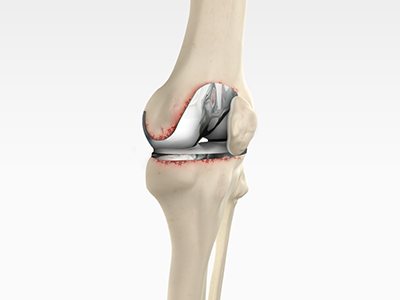 Revision knee replacement surgery involves replacing a part or all your previous knee prosthesis with a new prosthesis. Although total knee replacement surgery is successful, sometimes the procedure can fail due to various reasons and may require a revision surgery.
What is Arthritis?
The knee joints are lined by soft articular cartilage that cushion the joints and aid in smooth movement of the joint bones. Degeneration of the cartilage due to wear and tear leads to arthritis, which is characterized by severe pain.
What is Total Knee Replacement?
During total knee replacement, the damaged cartilage and bone is removed from the knee joint and replaced with artificial components. Artificial knee joints are usually made of metal, ceramic or plastic, and consist of the femoral and the tibial components.
Colorado Springs Orthopaedic Group
Dr. Economedes is a board-certified orthopedic surgeon specializing in hip and knee replacement, adult joint reconstruction, and arthritis care. Fellowship trained in Adult Joint Reconstruction at Rush University Medical Center, he provides comprehensive treatment for joint pain and mobility issues. Dr. Economedes is committed to helping patients regain function and improve quality of life through personalized care and advanced surgical techniques.
What are the Indications for Revision Knee Replacement?
Revision knee replacement surgery may be advised if you have one or more of the following conditions:
- Trauma to the knee joint
- Chronic progressive joint disease
- Increased pain in the affected knee
- Worn out prosthesis
- Knee instability or a feeling of giving way while walking
- Loosening of the prosthesis
- Infection in the prosthetic joint
- Weakening of bone around the knee replacement - a process known as osteolysis (bone loss)
- Stiffness in the knee
- Fracture
What is the Procedure for Revision Knee Replacement?
Revision knee replacement surgery may involve the replacement of one or all the components.
The surgery is performed under general anesthesia. Your surgeon makes an incision over your knee to expose the knee joint. The kneecap along with its ligament may be moved aside so that there is enough room to perform the operation. Then, the old femoral component of the knee prosthesis is removed. The femur is prepared to receive the new component. In some cases, the damaged bone is removed and bone graft or a metal wedge may be used to make up for the lost bone.
Next, the tibial component along with the old plastic liner is removed. The damaged bone is cut and the tibia is prepared to receive the new component. Like the femur, the lost bone is replaced either by a metal wedge or bone graft. Then, a new tibial component is secured to the end of the bone using bone cement. A new plastic liner will be placed on top of the tibial component. If the patella (kneecap) has been damaged, your surgeon will resurface and attach a plastic component. The tibial and femoral components of the prosthesis are then brought together to form the new knee joint, and the knee muscles and tendons are reattached. Surgical drains are placed for the excess blood to drain out and the incision is closed.
What are the Risks and Complications of Revision Knee Replacement?
Like all major surgical procedures, there may be certain risks and complications involved with revision knee replacement surgery. The possible complications after revision knee replacement include:
- Stiffness in the knee
- Infection
- Bleeding
- Formation of blood clots in the leg veins
- Injury to nerves or blood vessels
- Prosthesis failure
- Patella (kneecap) dislocation
- Ligament injuries
What Does Postoperative Care for Revision Knee Replacement Involve?
Following revision knee replacement surgery, a continuous passive motion (CPM) machine may be used to allow your knee joint to slowly move. The machine, attached to the treated leg, slowly moves the joint through a controlled range of motion, while you are at rest.
You can walk with crutches or a walker. You will be sent for rehabilitation within a couple of days of surgery. A physical therapist will teach you specific exercises to strengthen your leg and restore range of motion to the knee. Your physical therapist will also provide you with a home exercise program to strengthen the thigh and calf muscles.
Knee immobilizers are used when performing physical therapy, walking and while sleeping to keep the knee stabilized.
Why Choose Dr. Demetri M. Economedes for Revision Knee Replacement in Cary, Holly Springs & Morrisville, NC?
Dr. Demetri M. Economedes specializes in hip and knee joint replacement, including revision arthroplasty. His advanced fellowship training in adult joint reconstruction provides focused expertise in complex hip and knee replacement procedures.
Patients considering revision knee replacement can benefit from:
- Specialized joint replacement expertise: Dr. Economedes focuses on hip and knee reconstruction, joint replacement, and revision arthroplasty.
- Individualized treatment planning: Each revision procedure is different. Evaluation considers the condition of the implant, bone quality, stability, alignment, symptoms, and overall health.
- Comprehensive evaluation: Imaging and clinical assessment can help identify issues such as implant loosening, infection, instability, wear, bone loss, or fracture.
- Advanced revision techniques: Depending on the underlying problem, revision surgery may involve replacing one or multiple components and addressing bone loss or soft-tissue problems.
- Focus on restoring mobility: Treatment is designed to relieve pain, improve knee stability and function, and help patients return to appropriate daily activities.
- Convenient Triangle-area locations: Dr. Economedes provides care through locations in Cary, Holly Springs & Morrisville, NC, serving patients throughout the surrounding Raleigh-area communities.
Revision Knee Replacement FAQs
Revision knee replacement may be considered when a previous knee replacement causes persistent pain or develops a complication such as implant loosening, infection, instability, significant wear, stiffness, fracture, or bone loss. The appropriate treatment depends on the underlying cause.
Symptoms may include increasing knee pain, swelling, stiffness, instability, a feeling that the knee is giving way, reduced mobility, or difficulty performing activities that had previously become easier after surgery. These symptoms do not always mean the implant has failed, so an orthopaedic evaluation is important.
Yes. Revision surgery can be more complex because the surgeon may need to remove existing components, address bone loss, manage scar tissue, and restore knee stability and alignment. The complexity varies depending on why the original replacement needs revision.
Not necessarily. Depending on the cause of the problem, revision surgery may involve replacing one component, several components, or the entire knee prosthesis. Your surgeon will determine the appropriate approach based on your examination and imaging.
During revision surgery, the existing implant components that require replacement are removed. The bones are prepared for the new components, and bone grafts or specialized implants may be used when bone loss is present. New components are then positioned to restore knee alignment, stability, and function.
Recovery varies depending on the complexity of the revision, your overall health, bone quality, and rehabilitation needs. Physical therapy generally plays an important role in restoring strength, motion, and function after surgery.
The goal of revision surgery is to address the underlying cause of implant failure and improve pain, stability, and function. However, as with any major surgery, outcomes vary from patient to patient.
Dr. Economedes provides hip and knee joint replacement care in Cary, Holly Springs & Morrisville, NC, North Carolina, serving patients throughout the surrounding Triangle communities.
Schedule a Revision Knee Replacement Consultation
Persistent pain or instability after knee replacement should not be ignored. Dr. Demetri M. Economedes can evaluate your symptoms, assess your existing knee replacement, and discuss whether revision knee surgery or another treatment option may be appropriate.
Schedule a consultation with Dr. Economedes in Cary, Morrisville, or Holly Springs, NC, to take the next step toward a more comfortable and functional knee.